
Hypersonic Laminar Boundary Layer
Last week, we explored the asymptotic behaviour of post-shock Mach number and density ratio, leading to an asymptotic unit Reynolds number at the boundary-layer edge.
This raises a natural question: what happens in a shock-free flow?
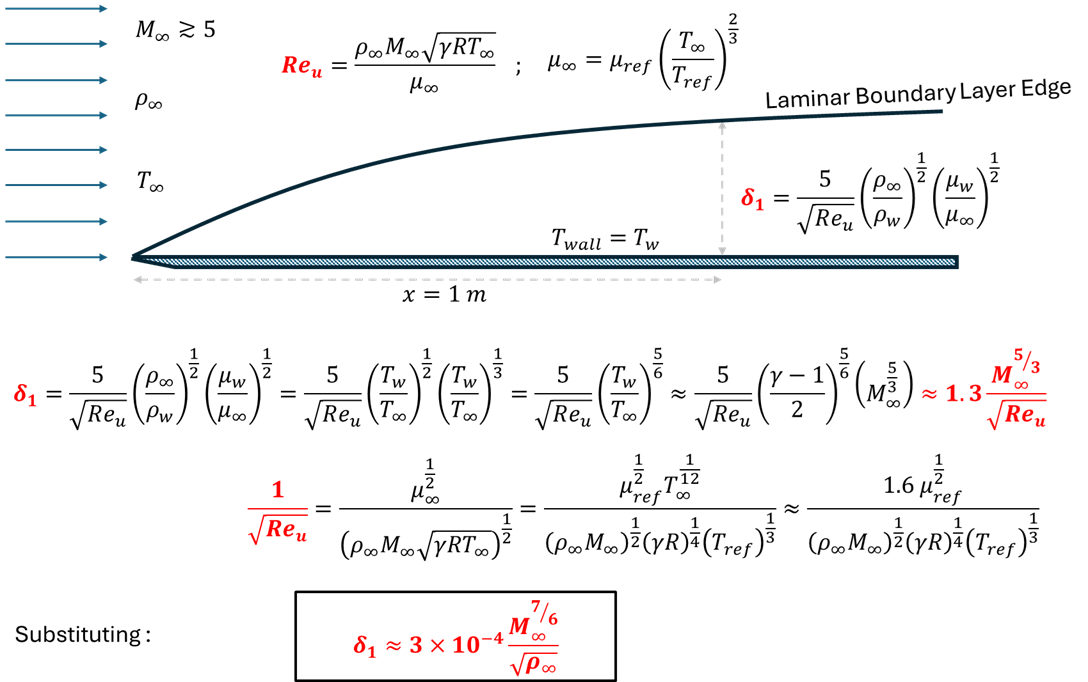
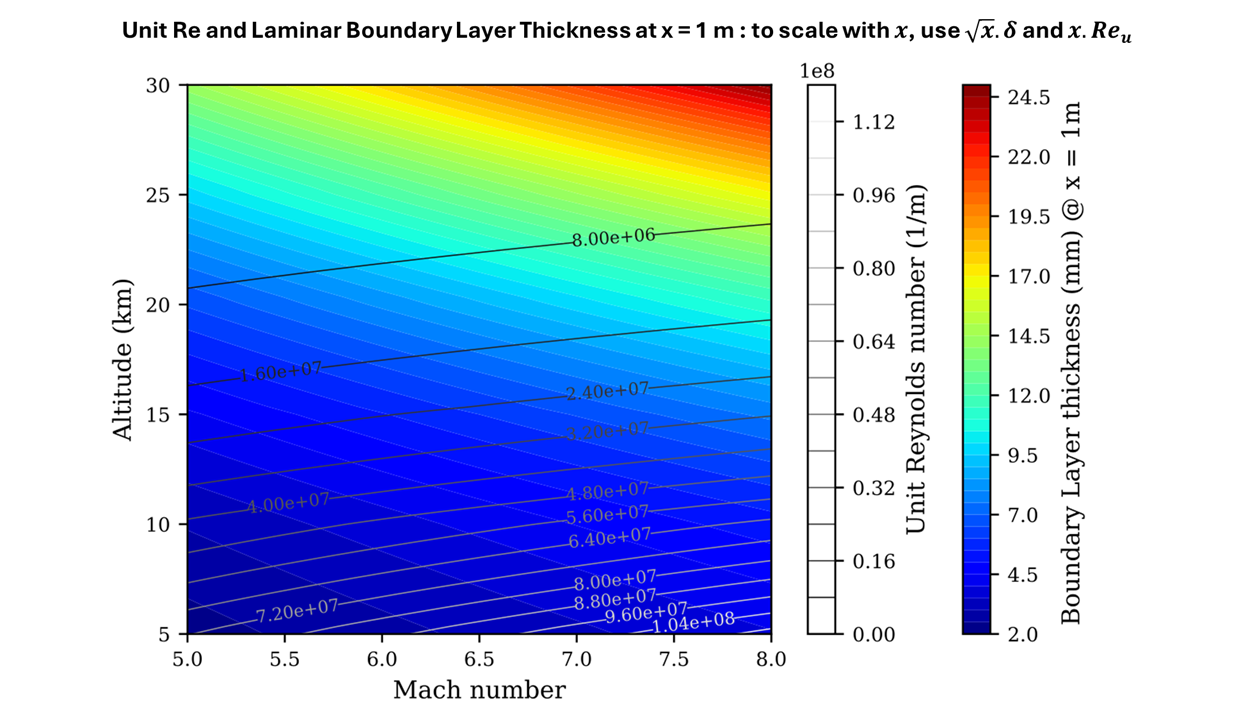
This week’s focus is an approximate solution for laminar boundary-layer thickness in shock-free hypersonic flow over a flat plate. The analysis is carried out at x = 1 m, making the unit Reynolds number easier to interpret, while the results can still be scaled with x, as shown in the figure. The laminar flat-plate boundary layer has a well-known self-similar solution — so how does hypersonic flow modify it?
What’s special about a hypersonic flat-plate boundary layer?
In the classical self-similar solution, boundary-layer thickness is estimated using free-stream properties to define the Reynolds number. Hypersonic flow fundamentally alters this.
At hypersonic speeds, kinetic energy is converted into thermal enthalpy near the wall, causing a strong temperature rise. This leads to two effects: reduced density and increased viscosity.
Both effects thicken the boundary layer relative to the incompressible case. Hence, hypersonic boundary-layer thickness must be scaled using near-wall fluid properties rather than free-stream ones. Using the ideal-gas assumption, Sutherland’s power law of viscosity, and isentropic relations, the expression simplifies. In classical form, laminar boundary-layer thickness scales as M^(5/3).
Note: The M^2 dependency in Hypersonic and High-Temperature Gas Dynamics by Prof. John D. Anderson assumes linear viscosity–temperature dependence.
How does this apply to atmospheric flight conditions?
Now consider a flat plate traveling at hypersonic speeds in the stratosphere.
Since unit Reynolds number also depends on Mach number, further simplification is needed to isolate Mach number effects at a fixed altitude. This is done by substituting the unit Reynolds number into the boundary-layer expression and simplifying it using Sutherland’s power law (with an approximation for fractional power of free-stream temperature).
The resulting laminar boundary-layer thickness, expressed in terms of free-stream density, shows direct proportionality to M^(7/6).
Why does this matter?
At higher altitudes: hypersonic flow tends to remain laminar due to lower unit Reynolds numbers.
At a fixed altitude: increasing Mach number (i.e., plate velocity) increases boundary-layer thickness non-linearly. This behaviour is unique to hypersonic flows, where kinetic energy significantly raises adiabatic wall temperature.
Ascending at constant Mach number also increases boundary-layer thickness due to decreasing unit Reynolds number.
These results provide a foundation for further modeling of derived parameters in hypersonic laminar boundary layers. Next week’s focus:
How to model laminar aerothermal load over a hypersonic flat plate?
